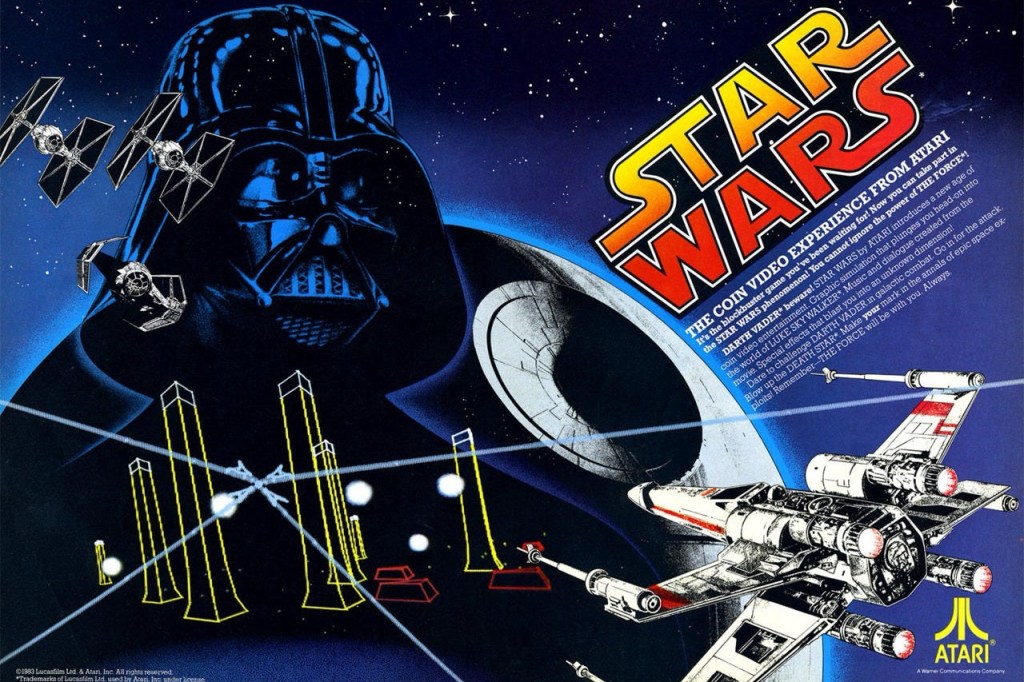
During the early 1980s arcade boom, a game arrived that changed everything—Atari’s Star Wars arcade game. Released in May 1983, it didn’t just entertain—it transformed the gaming world with groundbreaking graphics, immersive soundscapes, and innovative controls. This week, Rebel Briefing dives into the epic tale of how this iconic game transported players straight into the heart of a galaxy far, far away.
Growing up in the outer realms of west London, I lived in a triangle of ‘80s delights: a local video store stacked with VHS tapes (including the Star Wars movies), my favourite BMX shop with its Kuwaharas and Diamondbacks, and the nearby 7-11. A typical Friday evening after school included pocket money, a BMX ride to rent a movie, and ending with a Slurpee and time on Star Wars: The Arcade Game at 7-11. If there was a bright spot in the galaxy, this was it.
The Birth of a Galactic Odyssey
Until then, my Star Wars experience was limited to watching the films at home (Return of the Jedi was just about to hit theatres) and playing with my Kenner toys. The arcade game was my first step into a larger world.
Collaborating with Lucasfilm, Atari birthed a first-person space simulator centred around Star Wars: A New Hope. Developed by its talented team, Atari aimed to recreate the thrill of space battles, immersing players in the heart of the Rebel Alliance’s fight against the mighty Galactic Empire.
Revolutionary Vector Graphics
What set this game apart was its use of revolutionary vector graphics. Unlike traditional raster graphics, vectors allowed for smooth, crisp lines and shapes, creating a visually striking and immersive experience. The X-wing and TIE Fighter models, constructed entirely of lines, seamlessly soared across the screen, replicating the iconic spaceships from the Star Wars universe.
John Williams’ Score in 8-Bit Glory
One of the game’s defining features was its use of sound. It embraced the 8-bit capabilities of its time, delivering an immersive soundscape filled with blaster fire, explosions, and the unmistakable hum of lightsabers. John Williams’ iconic Star Wars score, though simplified, resonated through the arcade, adding a layer of authenticity to the gaming experience.
The Galactic Trench Run
At the core of the game was the recreation of the Death Star trench run, a pivotal moment from A New Hope. Players assumed the role of a Rebel pilot navigating the treacherous trench, avoiding obstacles, and delivering a precise shot to the Death Star’s exhaust port. For me, the game ingeniously translated this cinematic moment into an interactive experience, putting me in the cockpit of an X-wing as I battled against the clock and swarms of enemy TIE Fighters.
The Yoke Controller
To heighten the immersive experience, Atari introduced the yoke controller—a flight stick that mirrored the controls of an X-wing. This intuitive and responsive input device allowed players to instinctively manoeuvre their spacecraft, adding a layer of realism and excitement to the gameplay. Gripping the yoke contributed to the game’s allure, making me feel as if I were truly piloting an X-wing in the heat of battle.
The Legacy of Atari’s Galactic Journey
The Atari game left a lasting mark on the gaming landscape and the Star Wars franchise. It captured the essence of the original trilogy, translating the excitement and spectacle of space battles into an interactive format. Its success paved the way for future Star Wars video game adaptations, setting a standard for immersive gameplay and authentic representation of the source material for decades to come.
A Galactic Triumph in the Arcade Universe
As arcades evolved and technology advanced over the years, the game remains a revered relic of gaming history. Its revolutionary vector graphics, immersive sound design, and innovative controls transported me deep into the Star Wars universe. As a kid, Atari’s game wasn’t just entertainment—it was a magical portal. It blended the thrill of space battles with the unforgettable experience of piloting an X-wing against the Empire. To this day, the game stands as a testament to the enduring power of Star Wars to captivate imaginations and redefine gaming, ensuring its place as an iconic chapter in history.
 Rebel Briefing
Leave a comment